

You’ve done the maths. You know your target CPA. Your actual CPA holds under it. So the obvious next move is to spend more.
Here’s the good news most budget advice skips: you’re probably further from a problem than you think.
The ceiling is real, but it might be higher than you think
There’s a genuine effect where scaling ad spend eventually buys colder, less-qualified audiences, and CPA drifts upward as a result. It’s real. It’s also proportional, not absolute. It only bites once you’ve captured a meaningful share of the people actually available to you at your current spend level.
A trade business running $80 a day on Google Ads, or $3,000 a month on Meta, is unlikely to be anywhere near that point in most New Zealand regional markets. The addressable audience for a Christchurch plumber’s Google Ads account, or a residential real estate agent’s Facebook campaign, is usually a lot bigger than the current budget is touching.
Most New Zealand trade and service business spend sits somewhere between $50 and $150 a day (roughly $1,500 to $4,500 a month). The point where audience saturation actually starts showing up depends entirely on your local market size and how tightly you’re targeting.
How to actually tell if you're close
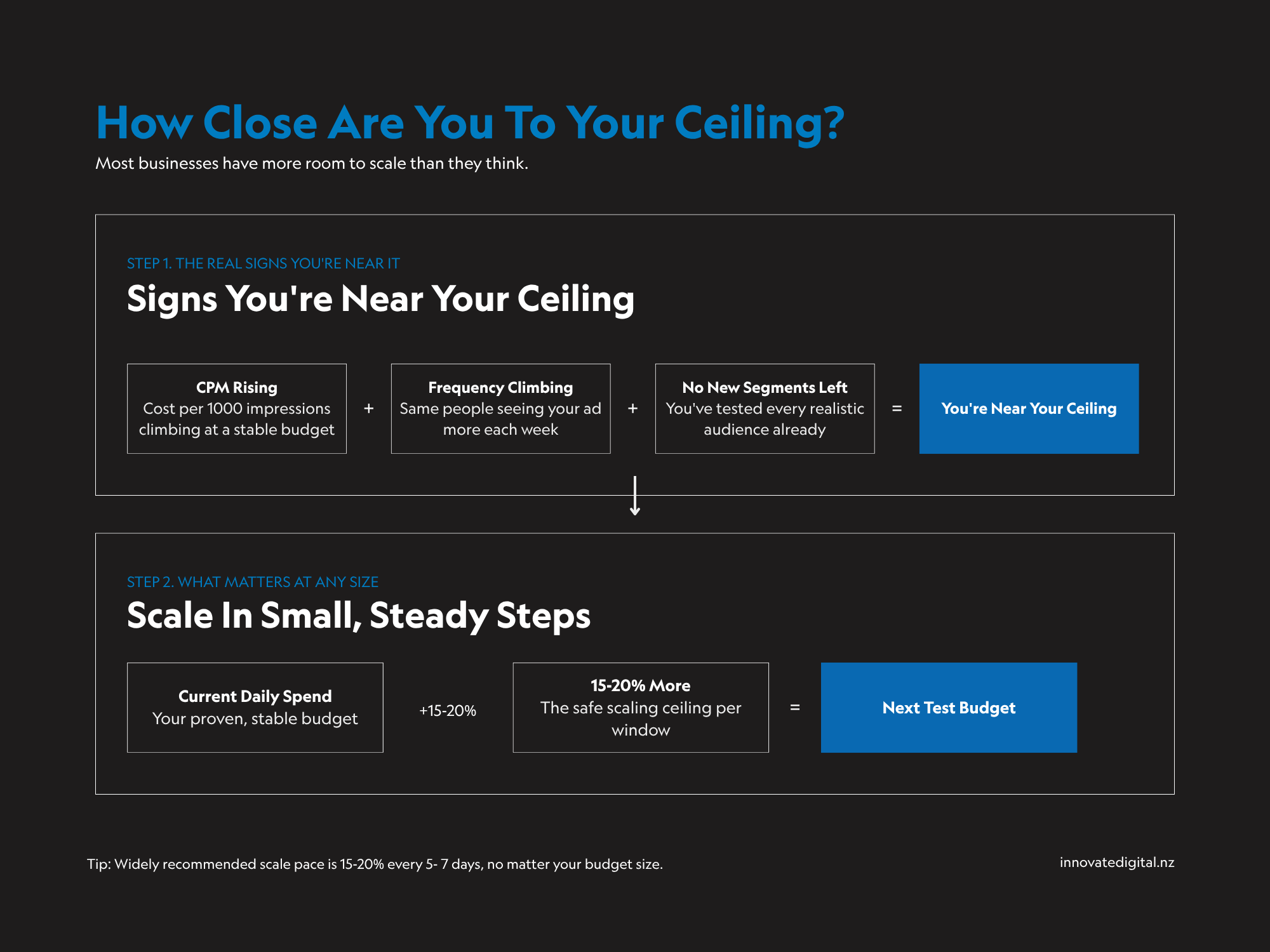
Rather than guess, watch for these three signs at your current, stable budget:
CPM is climbing even though nothing else about your campaign changed.
Frequency is climbing – the same people are seeing your ad more often each week.
You’ve run out of new audience segments worth testing.
If none of those are showing up, you likely have real room to increase spend before audience saturation becomes your limiting factor.
Tip: Google Ads has a specific “Limited by budget” status that tells you directly when your campaign is missing out on available traffic, a strong signal that raising spend will reach more of your audience.
The one thing that applies no matter your size: scale in increments
Here’s the part that has nothing to do with the ceiling, and applies whether you’re spending $50 a day or $5,000 a day.
Ad platforms need a stable pattern to optimise against.
Jump your budget too fast, even from $100 a day to $150 a day, and you can reset the algorithm’s learning phase and spike your CPA temporarily, regardless of how far you are from any audience ceiling.
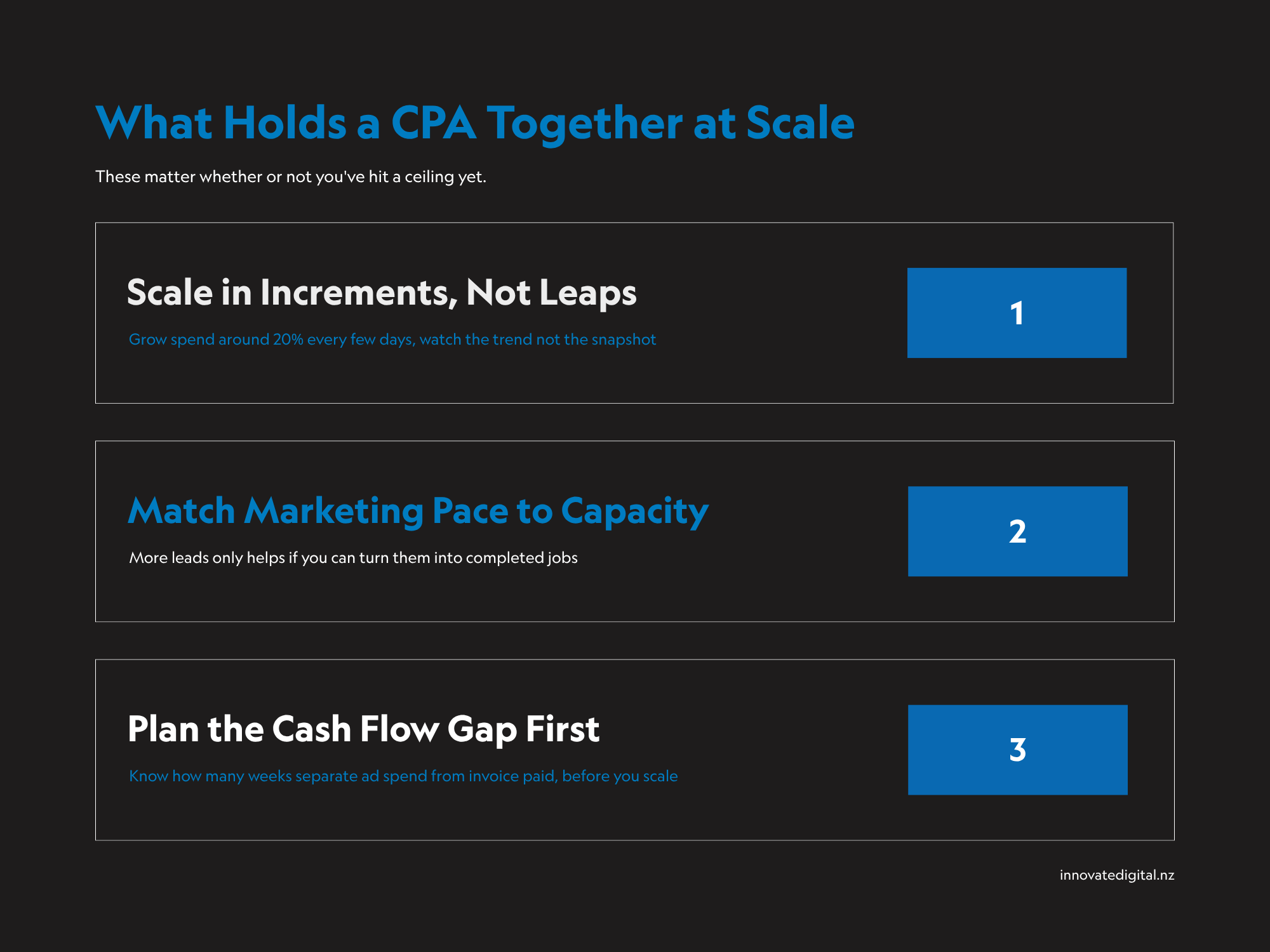
The practical fix: grow spend in increments. Roughly 15 – 20% every 5-7 days rather than doubling overnight. Track your CPA as a trend rather than a single-week snapshot.
Two more things that aren't about the ceiling at all
Even a business with plenty of headroom left can still run into trouble scaling, for reasons that have nothing to do with audience saturation:
Capacity. More leads only helps if you can turn them into completed jobs. A trade business that doubles ad spend without adjusting scheduling just builds a backlog, and a backlog erodes reviews, which raises your future acquisition cost regardless of what your CPA report says today. This is usually where a proper CRM and some automation earns its keep, automated booking, instant follow-up, and a queue that’s visible in one place stop a lead surge from turning into missed calls and slow replies, which is often the real reason capacity breaks before the tradesperson’s actual schedule does.
Cash flow. Ad spend happens now. The job, and the payment for it, land weeks later. A CPA that’s profitable on paper can still strain a business that hasn’t planned for the gap between paying for the lead and getting paid for the job.
What this actually means for you
If you’re running a modest, steady budget and your CPA holds, the honest answer is usually: you have room to grow it, and the ceiling isn’t your immediate concern.
What matters more, right now, is scaling gradually rather than jumping, and making sure your operations and cash flow can keep pace with whatever growth you create.