

Every business owner asks this question. Then they Google it, and every article gives the same answer: “5 to 10% of revenue.” You close the tab no clearer than when you opened it.
Here’s why that question is the wrong one to start with.
Start with the customer, not the percentage
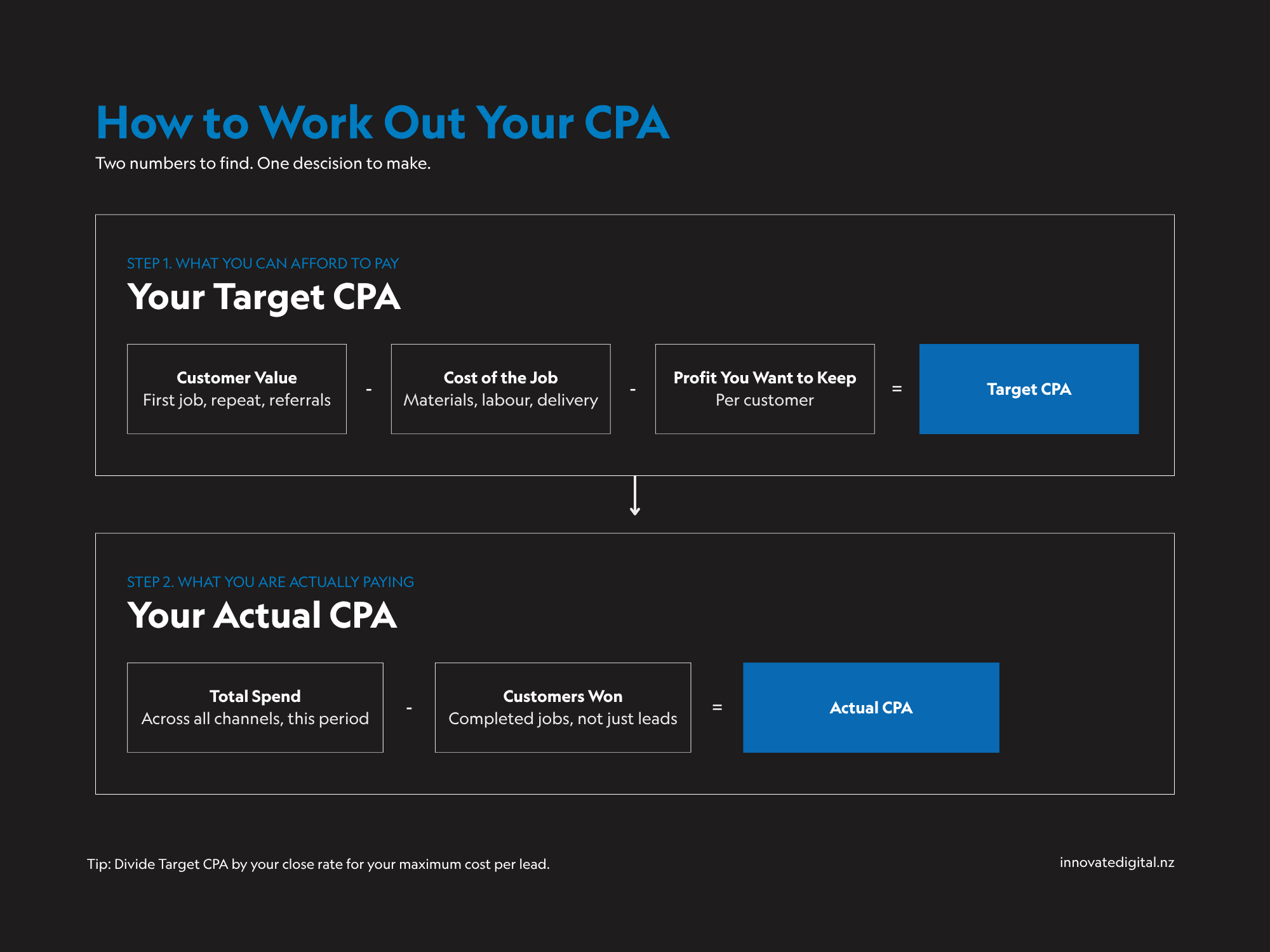
Before you touch a budget, answer four questions:
1. How many customers do you need to hit your target?
Not “more leads.” A number.
2. What's a customer actually worth to you?
First job, plus repeat business, plus referrals, over a realistic period.
3. What can you afford to pay to acquire one and still profit properly?
That’s your target cost per acquisition, your CPA.
4. What's your close rate?
The lever: why the cap isn't a percentage
Here’s the part most budget advice misses entirely. If your CPA holds – if every dollar you put in still comes back at a price you’re happy to pay – the ceiling on your spend isn’t a percentage of revenue. It’s not 8%, it’s not 10%. It’s as much as you can profitably deploy, full stop.
We heard about this recently from an agent we were talking with, who mentioned that one of the country’s better-known real estate agents reportedly put around half a million dollars into marketing last year and grossed close to $5 million in commission. We can’t verify that number publicly, so take the figure itself with a grain of salt – but the logic behind it doesn’t need verifying. If your cost to acquire a client is fixed and profitable, and the market can bear it, spending more isn’t reckless. It’s just more.
That’s the lever. So long as you can handle the volume it brings you, and the channel can still deliver customers at that price, there’s no reason to cap spend at a tidy percentage just because that’s what the textbook says.
It’s not an unlimited lever, though. Capacity and channel saturation both put a real ceiling on it.
If you don't have those numbers yet: the sanity check
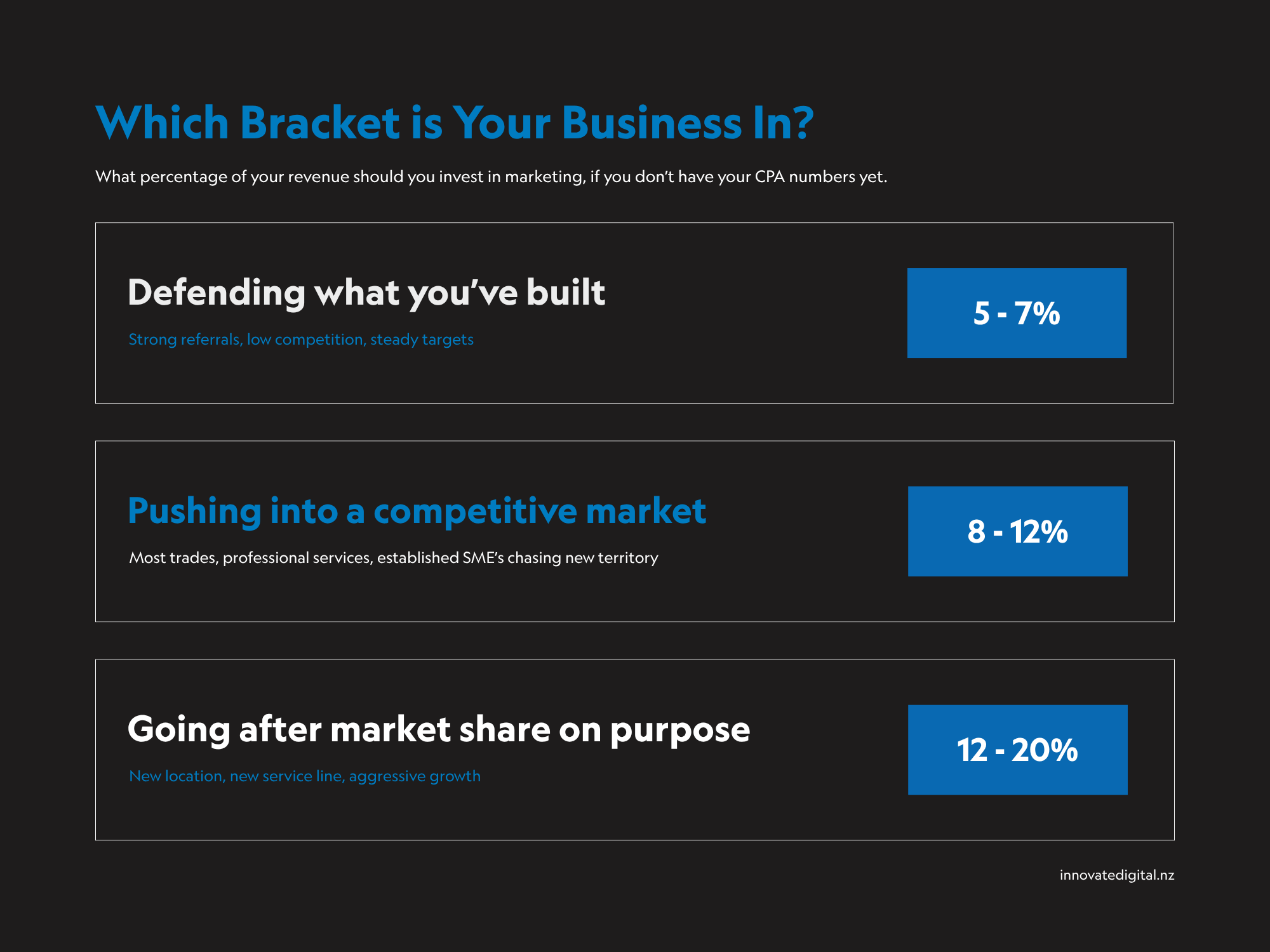
Most businesses don’t have clean enough tracking to calculate CPA and LTV properly yet. If that’s you, percentage-of-revenue is a reasonable placeholder until your attribution catches up. Here’s a rough guide, based on where your business sits:
Defending what you’ve built: strong referrals, low competition, steady targets: 5-7% of revenue.
Pushing into a competitive market: most trades, professional services, and established SMEs chasing new territory: 8-12% of revenue.
Going after market share on purpose: new location, new service line, deliberately taking customers off a competitor: 12-20% of revenue.
It’s worth knowing where that sits against the wider market too: the average Australian and New Zealand SME spends just 2-3% of revenue on marketing, against a global benchmark of 7.7%. If your competitors are spending at global benchmark levels and you’re at 2%, they’ve got three times the budget to show up in Google, Meta, and now ChatGPT. That gap compounds every month it’s left alone.
In real dollars, a business turning over $1-2 million a year in that middle bracket works out to $80,000-$240,000 annually – roughly $6,500-$20,000 a month. Which is where most of our own clients operate in, split across a well-built website, strategic campaigns across ongoing ads, SEO and AI search visibility, and a CRM that connects the dots from first click to completed job.
But treat this section as training wheels. The moment you can trace a lead to a completed job and know what that job was worth, throw the percentage out and use your actual CPA instead.
The mistake we see constantly
One of the biggest mistakes we see with businesses is owners taking a modest budget and spreading it across five channels – a bit of Google Ads, a bit of Meta, a blog post here and there, maybe an SEO retainer. Every channel gets just enough money to almost work, but never enough to prove itself.
$2,000 spread across five channels isn’t a marketing strategy. It’s five underfunded experiments running at once, and none of them get a real shot.
The businesses that grow fastest do the opposite. They pick the one or two channels that matter most for their industry, fund them properly, prove the CPA, then decide whether to push harder or add a new channel.
Where to actually start
If you can’t yet answer the four questions at the top of this post (customers needed, customer value, target CPA, close rate) that’s the actual starting point. Not the percentage. The percentage is just what you use while you’re building toward those numbers.
A business that can trace a lead from first click through to a completed job, and knows exactly what that job was worth, isn’t guessing at a percentage anymore. It’s defending its next dollar with a number, not a feeling.