
Your Leads Are Going Somewhere. The Question Is Where.
A lead comes in. A phone call, an email, a form on your website.
For most businesses, that lead lands somewhere different depending on how it arrived, a notebook for the phone calls, an inbox for the emails, a spreadsheet if you’re organised.
Nothing talks to anything else.
That’s the actual problem a CRM is meant to solve.
Not “more software.”
One place, one system, that catches everything.
What a CRM Actually Is
CRM stands for customer relationship management.
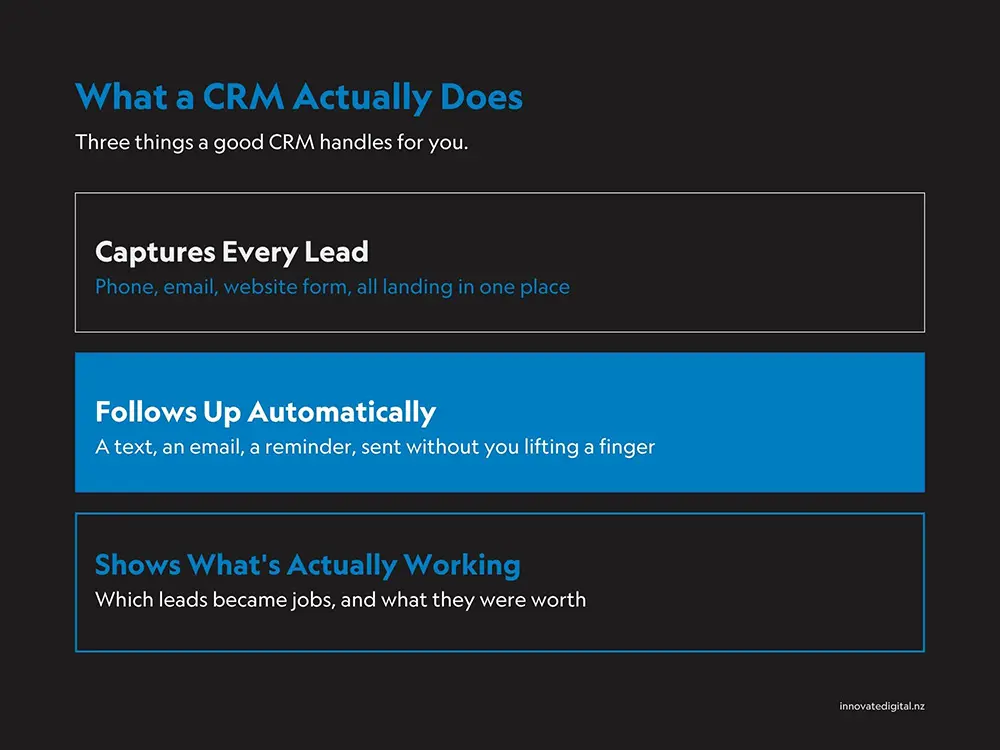
In plain terms, it’s the system that captures every enquiry, tracks where it’s at, and follows it up, automatically, without depending on someone remembering to.
That’s the baseline.
But “best CRM for business” isn’t really a software question.
It’s a systems question.
Why the Best CRM Isn’t Just a CRM
Most CRMs on their own are just a smarter contact list. They store names, numbers, notes. Useful, but limited.
The real value shows up when the CRM is part of a connected marketing system, meaning it talks to your website, your ads, and your booking process, rather than sitting off to the side as one more login to check.
A connected marketing system means:
- Your website sends every enquiry straight into the CRM, not into a separate inbox nobody’s checking
- Your Google ads platform can see which leads actually became paying customers, not just which ones filled in a form
- Your follow-up, quotes, reminders, review requests, happens on schedule, not when someone remembers
This is what people usually mean when they talk about integrated marketing.
Not five different tools bolted together.
One system, where the pieces actually pass information to each other.
How to Measure Digital Marketing Results Properly
Here’s where most businesses get stuck.
They can see how many people clicked an ad.
They can see how many leads came in.
What they usually can’t see is which of those leads actually turned into a job, and what that job was worth.
That’s the real gap.
Without a connected system, you’re measuring activity, clicks, form fills, calls, not results.
A properly connected setup closes that gap: the value of a completed job feeds back into your ad platform, so you can see which campaigns are actually making you money, not just generating enquiries.
That’s the difference between measuring digital marketing results properly, and just watching numbers go up without knowing what they’re worth.
What to Look for in a CRM
If you’re weighing up options, a few things matter more than the brand name:
- Does it capture leads from everywhere? Phone, email, website, social, all landing in one place, not scattered across different tools.
- Does it follow up automatically? Text, email, and reminders that go out on a schedule, not when someone gets around to it.
- Can it handle quotes and signatures? So a client can accept and sign without printing, scanning, or emailing anything back and forth.
- Does it connect to your ad platforms? So you can see which leads actually became paying work, not just which ones clicked.
- Does it do more than contacts? Email marketing, a unified inbox for Facebook and Instagram messages, Google Business Profile, and social media scheduling, all from the same place, are worth having rather than juggling five separate logins.
Most CRMs on the market do the first one or two.
Fewer do all of it properly.
How to Actually Choose One
Once you know what you need, the checklist above, the actual shopping part is easier than it sounds.
A good starting point: ask an AI tool like ChatGPT, or run a Google search and look at the AI Overview, to compare options against your specific list. Something like “CRM with automated follow-up, quote signing, and Google Ads integration for a trades business” gives you a far more useful answer than “best CRM for business“, because it’s matching against what you actually need, not a generic popularity ranking.
From there, a few things to actually check before committing:
- Ask to see it running for a business similar to yours, not just a features list
- Check whether setup and automations are built for you, or whether you’re left to configure it yourself
- Confirm it connects to the ad platforms and tools you’re already using, not just the ones it lists on its website
Why This Matters Even If You’re Small
It’s not really about volume. Even a handful of leads a week is worth having in one place instead of scattered across a notebook, an inbox, and whoever happened to answer the phone.
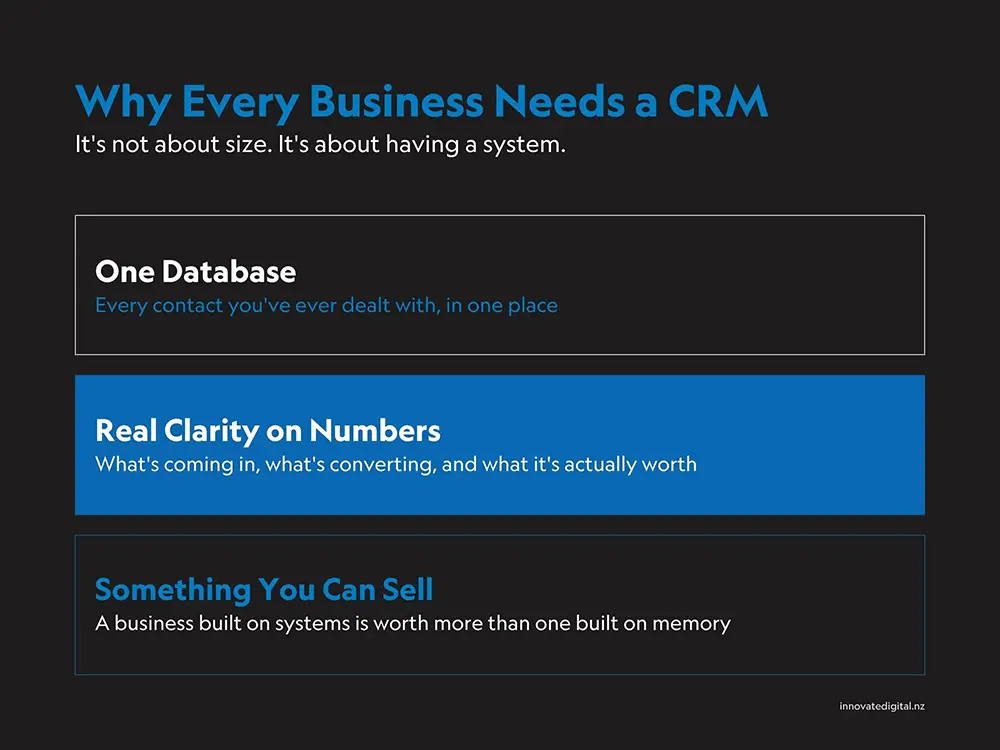
A single database of every contact you’ve ever dealt with.
Real clarity on what’s converting and what it’s actually worth.
And, longer term, something you can sell, a business that runs on one person’s memory isn’t worth much to a buyer.
One with real, trackable systems is.
A notebook or a shared inbox can just about hold together when it’s one person handling every enquiry. It stops working the moment there’s more than one person involved, or more leads coming in than any one person can track in their head.
At that point, the system isn’t optional anymore. It’s the thing standing between a lead and a lost job.
The CRM System We Build
A system like this is exactly what we build for clients who come to us for a website, Google Ads or Meta Ads campaigns, because marketing is only as good as the system that ties it all together.
As a GoHighLevel agency, we build out the entire CRM and Marketing system for tradies, moving companies and other businesses looking for streamlined, connected services.
If that sounds like what your business is missing, this is essentially what our Freedom Growth Framework is built around, a free website, a free CRM setup, and a growth partner running the whole system month to month. Check it out here.