

Your lead numbers are up. Your enquiries are converting. On paper, your Google Ads marketing campaign is working.
So why doesn’t it feel like it?
Not all customers are good customers
As a strategy-led agency, one of the first questions we ask businesses is “what does good business look like for you”, or “what does an ideal client look like”.
Invariably, the answer is “anyone”.
But not all customers are good customers.
“Everyone” is not an audience.
And even the businesses who have defined their target audience often can’t tell whether their marketing is actually reaching that customer. Because nobody’s connected the dots between a lead, whether it converted, and what it was actually worth.
Here's the pattern that shows up constantly
A roofing company runs a campaign and starts getting steady enquiries. The leads convert. Jobs get booked. Everything looks healthy on a Google Ads report.
Except the jobs coming through are $200 patch repairs, not the $40,000 full roof replacements the business actually wants more of. Every one of those enquiries is a real customer. None of them are the wrong kind of lead in the sense of being fake or unqualified. They’re just not the customer the business is actually trying to attract.
A standard Google Ads set up can’t tell the difference. It shows the same numeric value of 1 for a $200 job as it does for a $40,000 one. Cost per lead treats them identically too, because cost per lead only measures how cheaply you filled the pipeline, not what the pipeline was actually worth.
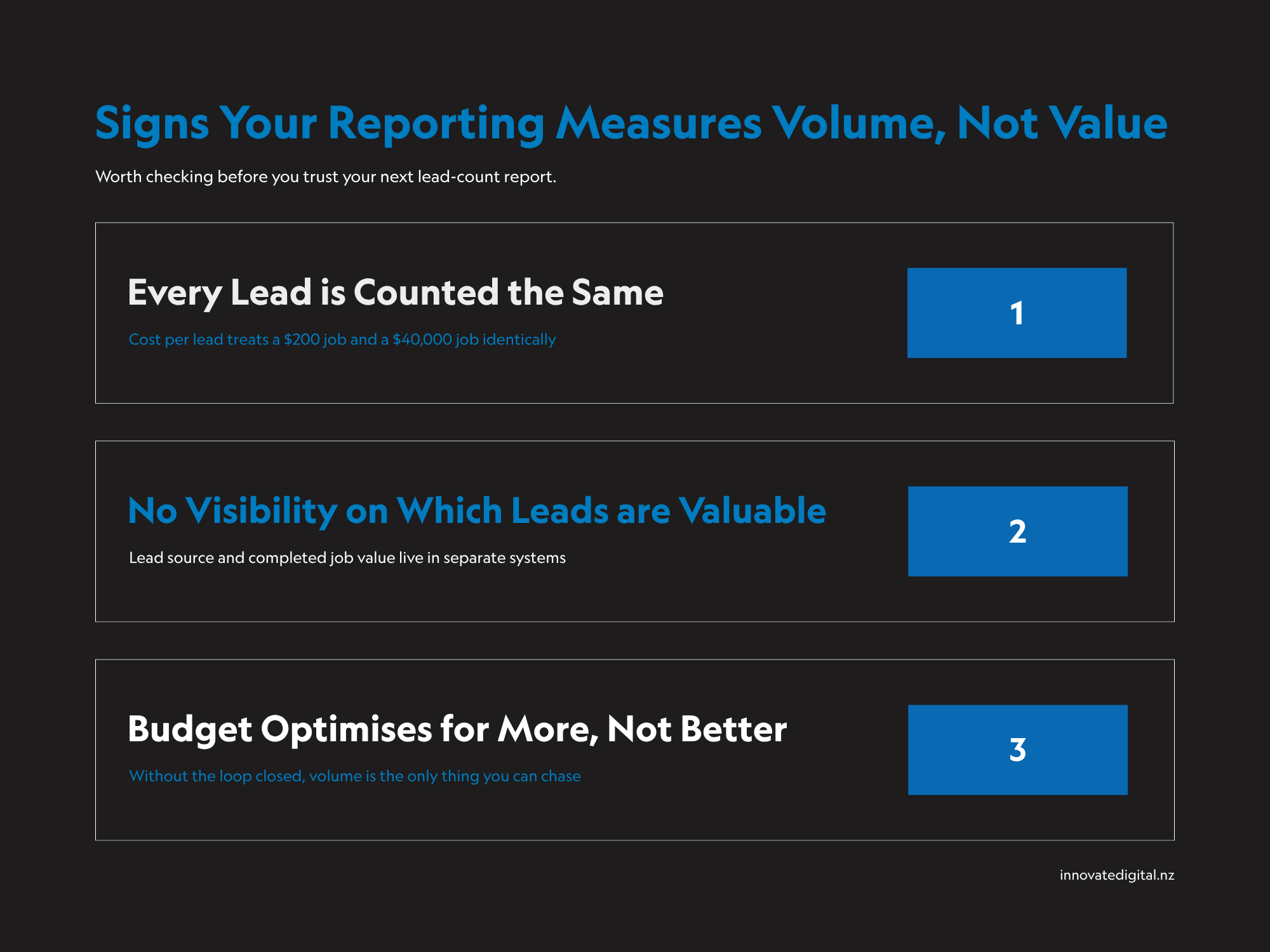
Why Your Ads are Attracting the Wrong Leads
Usually Google Ad campaigns that attract the wrong leads happens because:
– Your campaign messaging is broad enough to invite anyone (not just the customer you actually want).
– Your campaign is built to maximise enquiry volume rather than enquiry fit.
– There’s no qualification step between “someone filled out a form” and “someone matches the job size we want.”
– There’s no closed-loop attribution, that actually sends real converted data back into your Google Ads campaign (so instead of showing “1 lead” it can show “1 converted lead” and a value of “$200” or “$40,000”).
None of these are unusual mistakes. They’re what happens when the strategy hasn’t been mapped out and the system hasn’t been built as a closed loop.
The real problem: Your Marketing Isn't A Connected System
Here’s the part that most business owners and agencies miss. To know which campaigns bring $200 customers, and which bring $40,000 customers, someone has to connect where the lead came from, if it converted, and what the completed job was actually worth.
This isn’t a setting you switch on.
Google Ads doesn’t natively know that a lead form submission became a converted sale 6 weeks later. And a CRM doesn’t natively know what a job in Fergus, ServiceM8, or Quotient actually sold for.
Getting that data to flow back requires someone to actually build the connection, mapping job completion and value in one system to lead source in another, and keeping it accurate as both systems get used day to day.
It’s the kind of integration work most agencies skip, because it’s genuinely complicated.
It’s the piece we’ve built our own systems around: wiring the CRM we deploy as part of our marketing packages as the hub between Google Ads and whatever job management software a client runs, so a lead’s actual value makes it back to where the campaign decisions get made.
Without that connection, an agency can report on lead volume all day long, and still have no way to tell you which ads, campaigns, or landing pages are bringing your best customers and which are flooding you with jobs too small to be worth running.
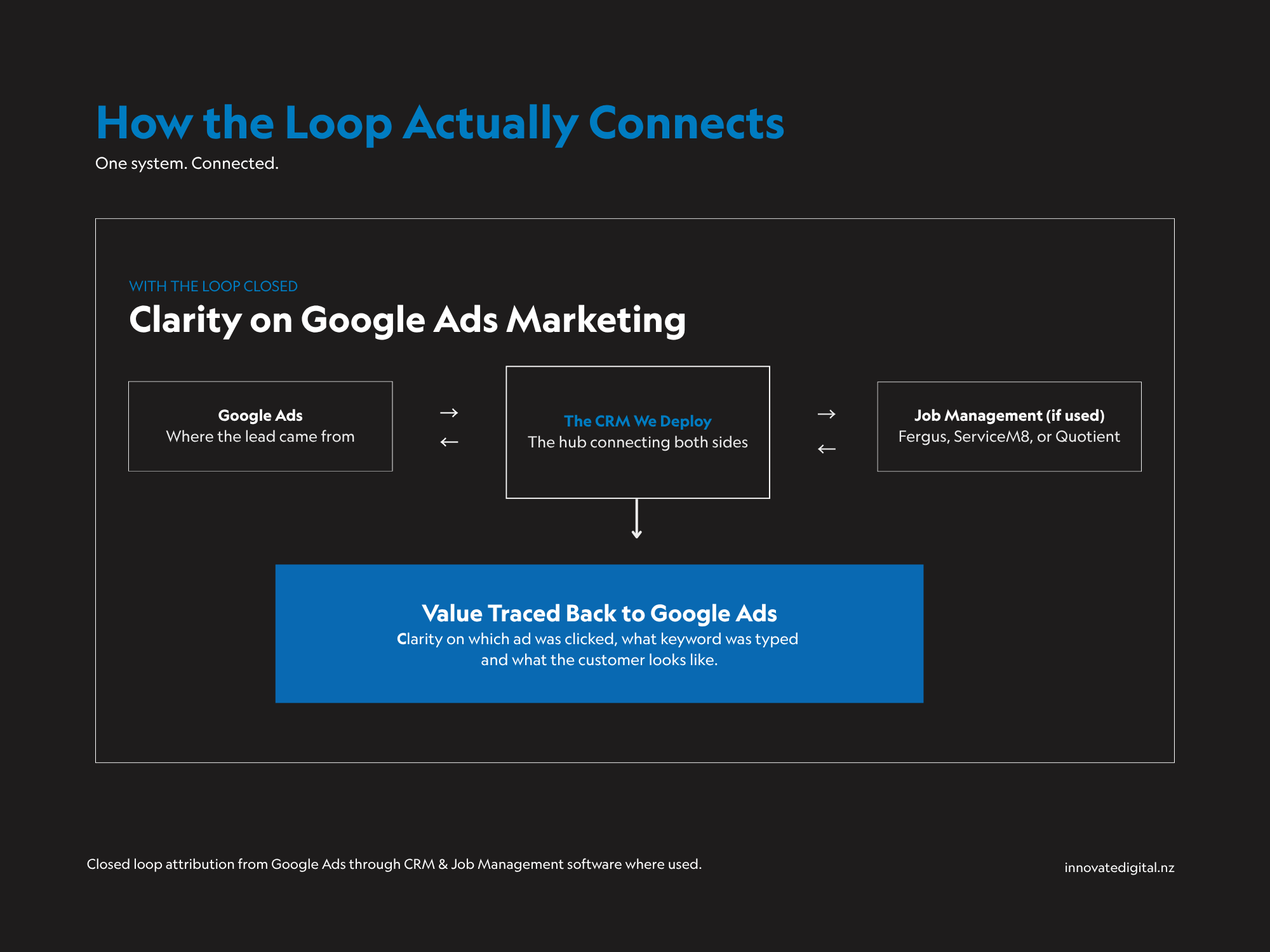
What closing the loop actually gets you
Once lead source is connected through to completed job value, the question changes from “which Google Ads campaigns bring the most leads” to “which Google Ads campaigns bring the customers actually worth having.”
That’s a different question, and it doesn’t always point to the campaign you’d expect from a lead-count report alone.
It also means budget can shift toward the specific campaigns and keywords producing your $40,000 jobs, and away from the ones filling your calendar with $200 ones, a decision no amount of lead-volume reporting can make for you.
What to ask your agency
If you’re not sure whether your current reporting can see this, ask one direct question: can you tell me the number of converted leads my ads generated, and the value of them? If the answer is no, your reporting can only tell you how busy your marketing kept you. It can’t tell you whether it brought you the right business.