

Most businesses treat reviews like a chore, an afterthought. Business owners look at me sheepishly and admit it’s something they know they should be doing, but still haven’t gotten around to. Some ask a happy customer here and there. Others put a sign up at the counter. Others do nothing at all.
That’s not a strategy. And treating reviews like an afterthought is costing your business in more ways than you know.
Reviews are doing more work than reputation
Reviews used to be about reputation, plain and simple: a good rating made people trust you a bit more. That’s still true, but it’s no longer the whole story.
Reviews now feed directly into Google’s local ranking algorithm, and increasingly into what AI Overviews and AI tools say about you when someone asks for a recommendation. Reputation and visibility used to be two separate things. For local businesses, they’ve largely merged into one.
That means a weak review habit isn’t just a missed trust opportunity. It’s actively working against your ad spend, your SEO, and your AI visibility, all at once.
Responding actually moves the needle, on both sides
Responding to reviews is often missed by many businesses.
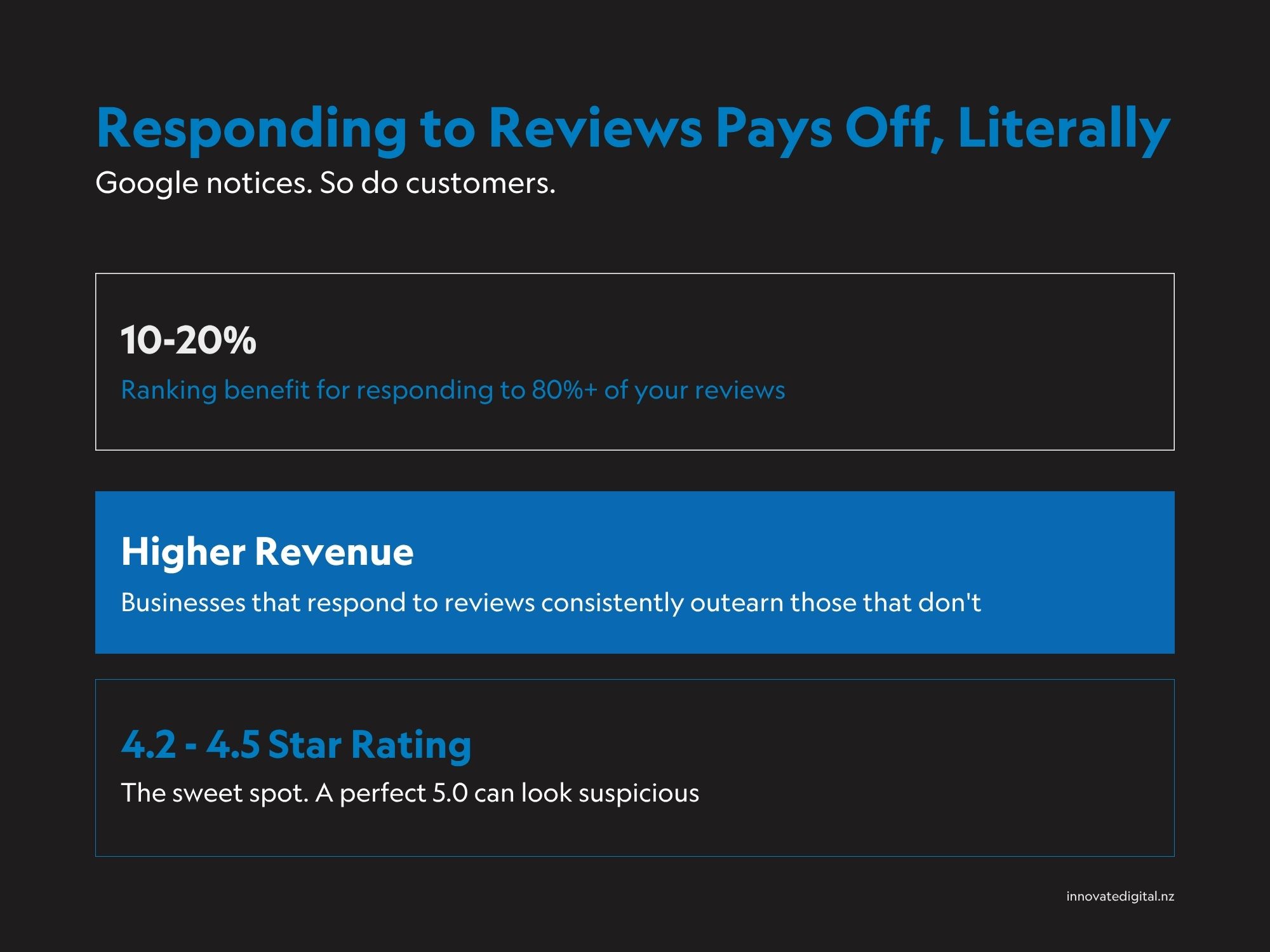
Responding to reviews, positive and negative, is a confirmed positive signal in Google’s own ranking behaviour, and it shows up in revenue too: businesses that respond to reviews see meaningfully higher revenue than those that don’t. One estimate puts the ranking benefit at 10 to 20% for businesses responding to more than 80% of their reviews.
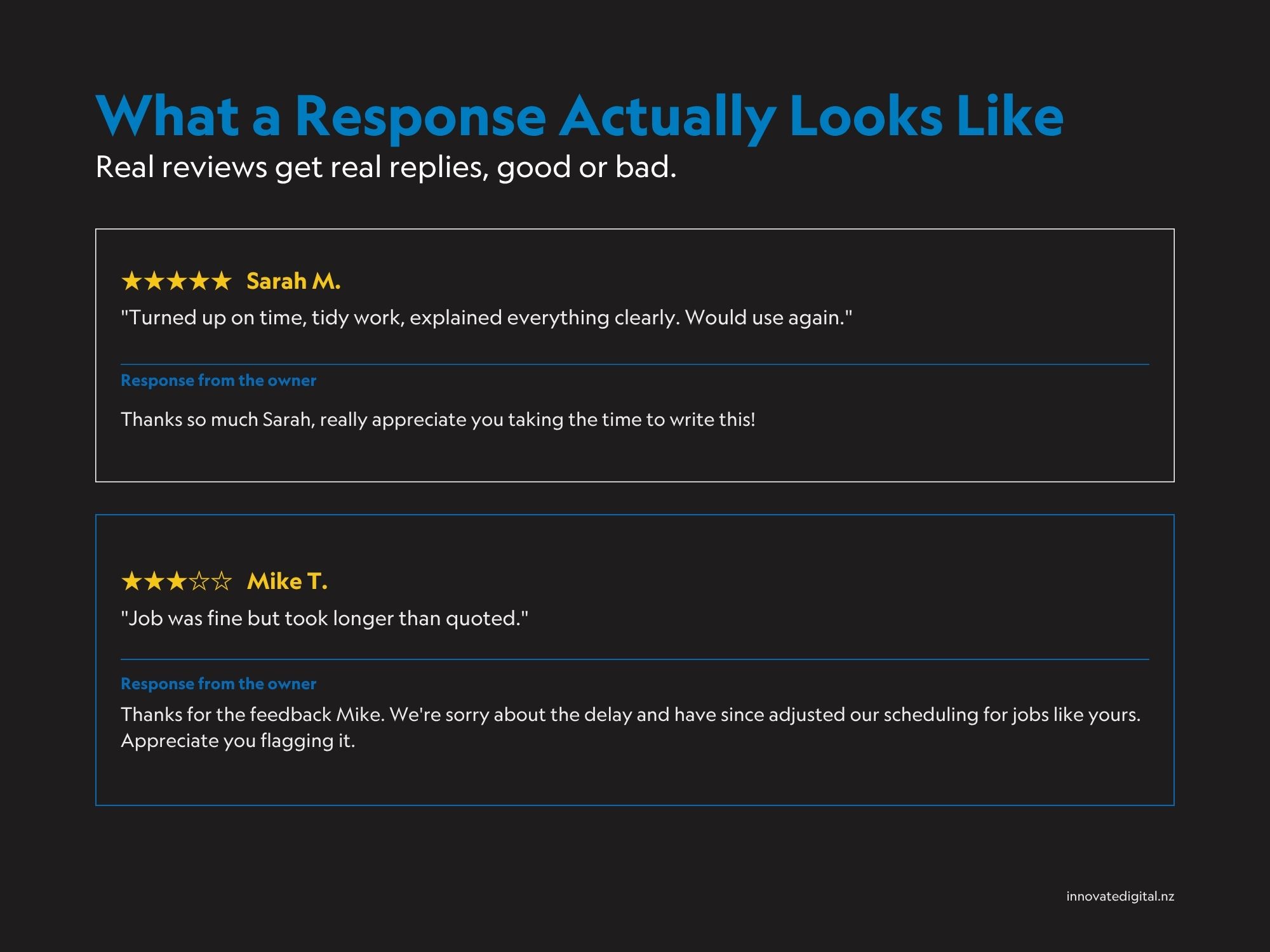
Reply to the five star reviews. Reply to the two star reviews. Ignoring the bad ones doesn’t make them less visible, it just makes you look like nobody’s home. People read the negative reviews before they book. What they’re actually checking isn’t the complaint, it’s how you responded to it.
You don’t need a perfect rating
Many businesses worry about getting bad reviews. But here’s the thing: a perfect 5.0 star rating can actually look suspicious to some consumers. The sweet spot most research points to is somewhere between 4.2 and 4.5 stars. A handful of average reviews sitting inside a strong overall pattern reads as authentic. A flawless record can read as manufactured.
Most consumers are comfortable engaging with a business sitting at 3 to 4 stars. We all expect there to be a poor review at some point for any business. So a couple of negative reviews inside a strong average doesn’t mean dented trust. What actually damages trust, is not replying to the negative reviews.
Why reviews need to be natural and unbiased
Here’s the temptation: only ask happy customers for a review, and quietly steer anyone unhappy toward a private complaint channel instead.
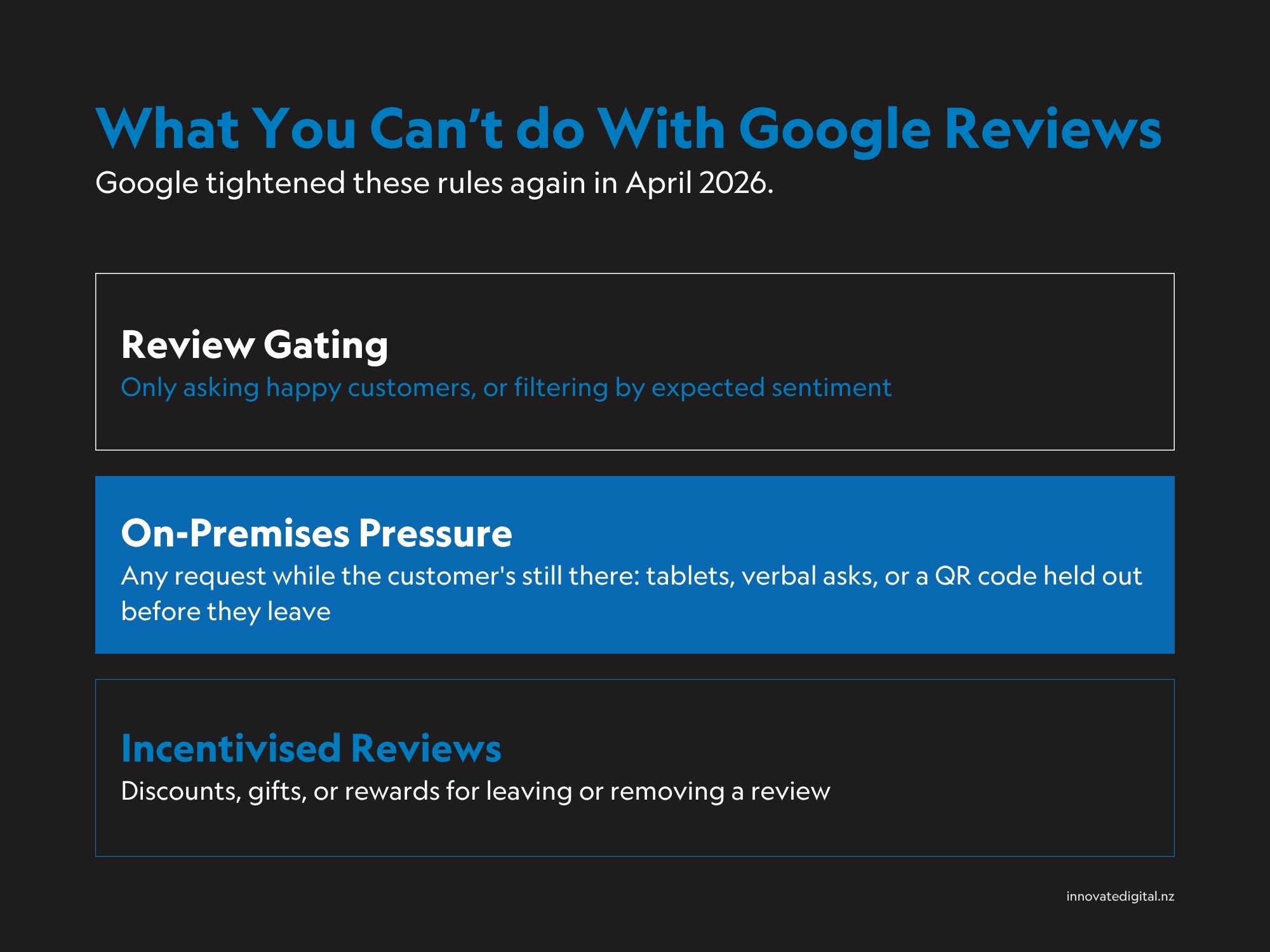
This is called review gating, and it isn’t a grey area. Google explicitly bans it, and enforcement is active and automated: the violation isn’t the ask, it’s the filter, sending review requests to some customers and not others based on how happy you expect them to be.
Google tightened these rules again in April 2026, also banning review quotas, asking customers to name specific staff members, incentivising reviews, and requesting reviews from customers while they are still on the premises.
The consequences are real and global, regardless of where your business is based: Google can strip your reviews (including legitimate ones), display a public warning banner, freeze new reviews, or suspend your profile entirely, which means disappearing from Search and Maps altogether.
In the US, businesses also face direct exposure under an FTC rule against review suppression, with penalties up to roughly $51,700 per violation. While we don’t face such fines here in New Zealand, Google’s enforcement is global and doesn’t care which country you’re in.
The safe, compliant version is simple: ask every customer, not just the ones you think will say something nice. If someone’s unhappy, that’s information worth having anyway, and a business that responds well to a bad review in public often earns more trust than one with a suspiciously spotless record.
What an actual review system looks like
Not complicated, just consistent:
- Ask after every completed job, after the customer has actually left, not a manual afterthought some weeks and not at all other weeks.
- Ask everyone, not a filtered subset based on how happy they seemed.
- Respond to every review within a few days, good or bad.
- Treat it as an ongoing habit, not a one-time campaign you ran when you first set up your profile.
If you have a ecommerce store, or actively use a job management software or CRM, this process can be completely automated.
So in 2026, your review strategy is not about chasing a perfect scorecard. It’s about consistently, honestly showing Google, AI tools, and everyone reading your profile that you’re an active, real business right now. Old reviews signal that you used to be a great business, recent reviews signal you are still a great business.